Marcela Nievas
Senior iOS Developer

MY HISTORY - in progress
In the late 80's and early 90's, I developed several small games just for fun.
Gussy was written in Z-80 assembler. Burbuja John was written in 8086 assembler, and the others were written in MSX BASIC.


Texas Instrumental Ti 99/4A
In the 1983 my dad was rewarded as best regional manager at a Ford dealership. He won a 'Computer' called Texas Instrumental TI 99/4A.
In my mind the first though was, where to put it?
The only notion of a computer I had at that time was the 'Bat Computer' from Batman and Robin in the TV Show.
And most important what to do with it?...
The expectation was high. My sister, 2 years older, and I were waiting patiently the arrival of the prize.


First look
Once the computer arrived home I was a bit disappointed. It was quite small and not even close to what I has in mind.
Thankfully, it came with a manual written in Spanish which was pretty important since it was the only language I knew when I was 10.
My dad helped my sister and me connect it to our black and white TV to see the very first image.
So the only thing next was to press any key :)
This computer came with two cartridge games.
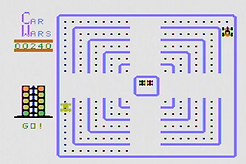
Car War, which had the spirit of PacMan and another one which I cannot remember. A time later, for Christmas we asked for another game, Parsec.
After playing hours and hours of those games, with my sister we started to dig into the manual to see what else to do.



First coding
Somehow, my dad hire a computing professor who had to take 2 busses to get home. He came few times once a week, to teach us some programming.
That was the kickoff to start doing something else than playing.
A bit later, my dad bought this book 'TI Games for Kids' in Spanish. Here other books I wish I had now.
Games in that book were about 150 lines long and it took me about an hour to type them on.
They were quite basic and they do what the manual indicated but the magic happened when I started to change the code randomly to see how the output changed.
Unfortunately, we did have a floppy disk or any other external device to store code. Every end of the day, everything was lost when we turned it off.


Talent DPC-200 MSX
Around 1986, my dad bought us a more modern computer. The Talent DPC-200 MSX. It came with a MS-DOS and the ability to use a dataset to store and recover data.
It also come with cartridge but it was not relevant anymore.
As a second computer, it was much easier to make something more interested than playing with it.
The manual, was in Spanish again, so it was not a blocker at that moment.

Games in Basic MSX
With this computer I started to make some small games in MSX Basic.
It has the possibility to have on screen up to 8 sprite with collision detection by hardware. The only caveat was that it can only be one color.
To make it multicolor, like 2 colors, I had to use 2 sprites with the same coordinates but being careful in avoiding the dots of each for touching one to another. And what was worse, use two sprite to represent one object on screen.
Finally, my small innocent games were one color sprite each.
Asteroids
When the game started, I used the command draw-line and fill to get a background, then a sprite to represent the aiming gun, a line which represented the fire of the gun and some asteroid falling down.
The aiming gun and the asteroid were sprites, so the detection was easy.


Guip
Guip was a little more complex game.
Still written in Basic, it draw the scene at the start and the main character had to collect falling fruits but touching it while jumping and at the same time, he had to avoid an arrow coming from left to right.
The energy bar added an extra layer of difficulty.


Scrunff
In Scrunff the main character had to collect carry flowers from left to right while avoiding the arrows.
Simple but it had a goal and a end.
At this time, I learnt how to modify the ASCII character. Each graph on screen was a letter replace by a pattern. That was a pretty common trick in this era.

Learning Z-80
When I was around 14, I knew that with BASIC language I would be able to do more sophisticated games. I had to learn assembler.
In downtown, there was a famous computer shop called Real Time where I used to buy new games.
While I was there with my mum, she asked casually if they knew about assembler classes. Surprisingly, they said yes.
Classes were about to start soon in their facilities.
I was in shock, I dream finally came true.
Real Time
To go to Real Time every Saturday, I had to take a train, a subway and walk 15 minutes. In total, it was an hour and a half, but it was worthy.
The first class I met my professor Ruben Benayon and other students. If I remember correctly, we were around 3.
Later I met other great programmers like Damián Palumbo, Jorge Contreras and Victor Erlich.
1990 - Games in Z-80
Along with my studies, I develop this game fully in Z-80.
As I remember, the compiler took 8 minutes to compile so I had to be sure of the coding before each compilation time.
As I was not a graphic designer, the alternative I found was to use a transparent plastic bag to copy images from an Disney encyclopedia. Then, with adhesive tape put that image over the TV and with a rudimentary graphic tool copy pixel by pixel on screen.
There were not a mouse at that time, so I guess I was just moving a cursor with the blue arrow from the keyboard.


Personal Computer 286 (PC)
Turbo button, what for?
The first personal computers come with a processor called 286.
They had a button to choose between normal speed and turbo speed and a reset button, dangerous close to the turbo button.
The assembler was 8086 family which was different from the Z-80 I learnt for the MSX.
A second assembler was easier to learn but it come with a new challenge, the BIOS.

Learning 8086
The first huge blocker was my English.
For the MSX, I had access to Spanish books and at the end I've got some English ones. But for 8086, all was in English.
The second one was the ROM BIOS.
The 8086 come with floppy disk and hard drives.
To access the BIOS to read drives I had to call the interruption 21 (INT 21) having specific values in the registers.
What is a handler?
As I remember, when reading the documentation, it said that to save a file, I had to send in interruption to 21 to get a handler.
In an English dictionary, a handler is described as thing to hold a pan to cook.
So it was not quite easy at that time to understand that the handler was no more than an identifier to save data.

1992 - First game in 8086 - Burbuja John.
The best way to learn a programming language is to actually using it. So the best solution was to create my first 8086 game.
The 286 come with DOS and later the Windows 3.0 which was launched from the DOS. It was a app, more than a OS.
In the 8086, to show graphics, the first thing was to turn on a graphic mode. There were no to many options. One of them was CGA, with a variety of 4 colors. Black, Cyan, Magenta and White.
And additional challenge was the lack of graphic tool to create the art. The solution, was to draw the art in paper and one by one copy the values in the source code.
As tedious as it sound, after a while, it was easy to create 'art' and quite rewarding to 'see' them alive.
The only problem I had was my monitor was Ambar (one color). This meant I never had the chance to see the real color until years laters in a borrow PC.


1991 - Now time to go to the university
Zero time for gaming... for now.